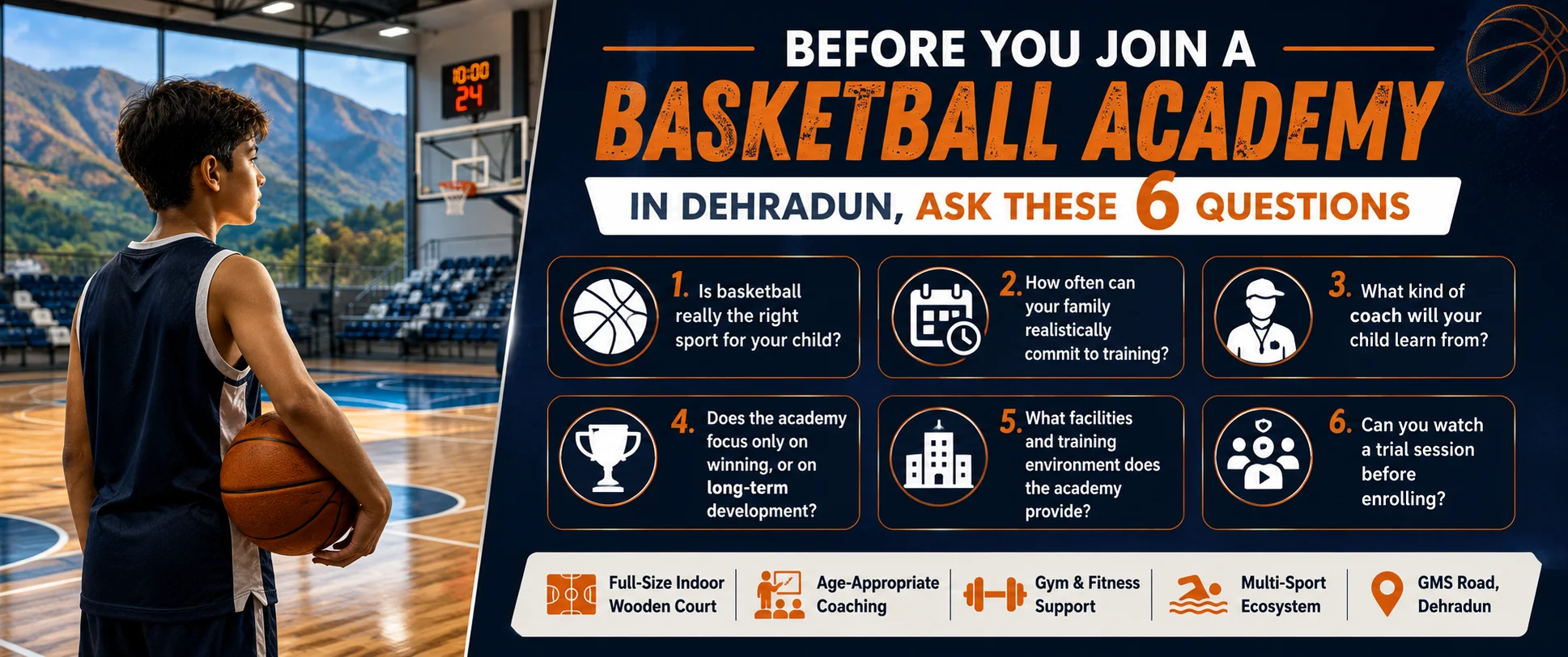
Before You Join a Basketball Academy in Dehradun, Ask These 6 Questions

If you’re searching for a basketball academy in Dehradun for your child — or for yourself — the real question underneath “best basketball academy” is usually a handful of smaller ones: is the court actually proper, is the coaching structured, what will it cost, and is this a place built just for basketball or somewhere with a longer runway. This guide answers all four.
Basketball coaching in Dehradun has historically meant a school gym, a cemented outdoor court, and whichever coach happened to be free that evening. That’s changed. JP High Performance Sports Academy on GMS Road runs a full-size wooden maple indoor basketball court, built to professional standards with seating for spectators — the kind of surface serious players need to develop real footwork and shooting mechanics, not just enthusiasm.
This guide covers what actually separates a good basketball academy from an average one, an honest look at what affects the fees, and — because JP isn’t only a basketball facility — why training inside a multi-sport ecosystem rather than a single-sport gym is a genuine advantage for a growing player.
| At a Glance | |
| Court | Full-size indoor wooden maple court, professional standard, spectator seating |
| Age groups | 5–9, 10–14, 15–18, and 18+ adult batches |
| Access | Structured coaching plans plus pay-and-play access for non-members |
| Membership | Individual, family, and corporate plans available, monthly or annual |
| Hours | Open daily, 6 AM – 10 PM |
| Location | Behind Reliance Mart, Near Rohan Motors, GMS Road, Dehradun – 248001 |
| Contact |
+91 73021 78717 |
What Actually Separates a Good Basketball Academy From an Average One
Most parents and players evaluating basketball academies in Dehradun are comparing on instinct rather than criteria — which coach seems friendly, which place is closest to home. Both matter, but they’re not the whole picture. Here’s what’s actually worth checking.
1. The court surface itself. A cemented or painted concrete surface is fine for casual play but is genuinely harder on joints and slower to develop proper footwork on than a sprung wooden court. JP’s basketball court is full-size wooden maple, built to professional standards — the same category of surface used in competitive indoor basketball, not a repurposed hall.
2. Whether coaching is structured or improvised. A good academy runs age-appropriate, progressive coaching plans rather than one generic session for every player who walks in. JP structures batches by age group — 5–9, 10–14, 15–18, and 18+ — so a nine-year-old isn’t training alongside a seventeen-year-old on the same drills.
3. Whether the facility is single-sport or has a broader athletic base to draw on. Basketball performance depends heavily on lateral quickness, cardiovascular conditioning, and core strength — none of which come from shooting drills alone. An academy with access to a proper gym, conditioning space, and cross-training sports gives a player more complete physical development than a basketball-only gym ever can.
4. Flexibility of access. Some academies lock you into a single weekly slot with no flexibility. JP offers both structured membership plans and pay-and-play access for non-members, which matters if you want to try the court before committing, or if your schedule genuinely varies week to week.
5. Competitive and social exposure. A court with seating and a genuine indoor arena feel — rather than a bare hall — makes tournaments, inter-batch matches, and simply having friends and family watch practice matches a realistic part of training, not an afterthought.
6. What happens around the training, not just during it. Recovery, wellness, and a place for parents to wait comfortably all affect whether a training habit actually sticks. This is where a larger academy campus, rather than a single rented hall, starts to show its value — covered in more detail further down.
Read Also:
Why More Women in Dehradun Are Finally Learning to Swim — And What Changed
Basketball Academy Fees in Dehradun: What Actually Affects the Cost
This is one of the most searched questions from parents comparing basketball academies, and it deserves an honest answer rather than a made-up number — fee structures vary by academy, batch type, and season, and the only reliable way to get a current figure is to ask the academy directly. What’s genuinely useful to know beforehand is what actually drives the cost up or down, so you’re asking the right questions when you call.
- Membership type: individual, family, or corporate memberships are typically priced differently, and JP offers all three — a family plan covering two or more children is usually more cost-efficient per head than separate individual memberships.
- Commitment length: monthly plans cost more per month than annual plans in almost every academy structure, since the annual rate amortises the cost of onboarding and kit.
- Batch type: structured, coach-led group batches are priced differently from pay-and-play court access, which is JP’s more casual, no-commitment option for players who want to use the court without joining a structured programme.
- Age group and batch size: younger age-group batches with lower coach-to-player ratios can carry a different price point than larger teen or adult batches.
- What’s bundled in: some academies price basketball coaching separately from gym and conditioning access; at a multi-sport campus like JP, membership can sometimes bundle basketball with gym, swimming, or other facility access, which changes the effective cost per sport.
The straightforward way to get an exact number: call or WhatsApp the academy directly with your child’s age group and how many days a week you’re considering — +91 73021 78717 — and ask for the current basketball batch pricing. Fee sheets are typically updated by season, so a number quoted six months ago may no longer be accurate.
JP Sports: Basketball Inside Dehradun’s Most Complete Sports Ecosystem
This is the part that separates JP from a standalone basketball academy, and it’s worth explaining rather than just listing. A young basketball player’s biggest long-term advantage rarely comes from more basketball alone — it comes from the athletic base built around it: agility, lateral movement, core strength, and recovery. A single-sport basketball gym has no way to offer any of that. A multi-sport campus does.
What’s actually on the same campus
- Basketball: full-size indoor wooden maple court, professional standard, with spectator seating.
- Gym & conditioning: a 404 sqm multi-level gym with cardio, strength, and functional training zones — the exact kind of conditioning work that improves a basketball player’s speed, jump height, and injury resilience.
- Badminton: 8 indoor courts with maple wood and vinyl flooring, certified under the Padukone School of Badminton — badminton’s rapid direction-change demands build the same lateral quickness basketball needs.
- Squash: 2 WSF-approved glass-backed courts — short, explosive movement patterns that carry directly over to defensive footwork on a basketball court.
- Swimming: a half-Olympic, temperature-controlled indoor pool with a dedicated kids’ pool — genuinely useful for low-impact cardio conditioning on rest days between basketball sessions.
- Football, cricket, table tennis, and skating: a FIFA-approved 40×24m turf, cricket pitches with floodlit nets, an air-conditioned table tennis arena, and a 758 sqm skating rink round out a genuinely complete athletic environment, useful for cross-training or simply keeping a young athlete engaged across seasons.
- Yoga and Zumba: dedicated 160 sqm and 141 sqm studios — flexibility and mobility work that reduces injury risk in any court sport, basketball included.
None of this replaces dedicated basketball coaching — it supplements it. A player who trains basketball twice a week and adds one gym conditioning session and one badminton or squash session for footwork is, in practical terms, getting a more complete athletic education than a player doing basketball drills alone four times a week. This is the actual argument for choosing a multi-sport academy over a single-sport gym, not just a marketing line about variety.
The Club at JP — what’s around the training
For families spending several evenings a week at the academy, what happens around training matters more than it might seem. JP’s on-site Club includes a rooftop restaurant and terrace lounge, a billiards lounge, a children’s play zone for younger siblings, and a conference hall for events — the kind of infrastructure that turns “waiting for basketball practice to finish” into something less like a chore and more like part of the evening.
| JP High Performance Sports Academy — full-size wooden maple basketball court, structured age-group coaching, and a full multi-sport campus on GMS Road, Dehradun. |
Quick Answers
Is JP Sports a good basketball academy in Dehradun?
JP Sports operates a full-size indoor wooden maple basketball court built to professional standards, with seating and age-appropriate coaching batches from 5 years through adult. Combined with on-site gym, conditioning, and cross-training sports, it’s built to support serious basketball development rather than casual drop-in play alone.
What are the basketball academy fees at JP Sports in Dehradun?
Fees depend on membership type (individual, family, corporate), commitment length (monthly or annual), and whether you choose structured coaching or pay-and-play court access. Current pricing is best confirmed directly with the academy at +91 73021 78717, since fee sheets are updated seasonally.
Can beginners join basketball classes at JP Sports?
Yes. Batches are structured by age group — 5–9, 10–14, 15–18, and 18+ — and coaching is designed to take players from a beginner level upward, not only to train those with prior experience.
Is JP Sports only a basketball academy, or does it offer other sports?
JP is a multi-sport campus offering basketball, football, cricket, badminton, swimming, table tennis, squash, skating, and gym/fitness facilities, along with yoga and Zumba studios — positioned as one of the more complete sports academies in Dehradun rather than a single-sport facility.
Can I try the basketball court without a membership?
Yes. JP offers pay-and-play access for non-members alongside structured membership plans, so it’s possible to use the court on a one-off basis before committing to a coaching programme.
What are the timings for basketball classes at JP Sports?
JP High Performance Sports Academy is open daily from 6 AM to 10 PM. Specific batch timings for basketball vary by age group — contact the academy directly to confirm current slots.
A basketball court alone doesn’t make a basketball academy — the surface, the coaching structure, and what a young player can draw on around the game all matter. JP Sports on GMS Road brings a genuinely professional-standard court together with the wider athletic ecosystem a serious player eventually needs anyway.
If you’re comparing basketball academies in Dehradun on more than just proximity, this is worth a visit before you decide.
| JP High Performance Sports Academy — GMS Road, Dehradun. Open daily, 6 AM – 10 PM. |